Lessons From McKinsey’s Interview Bible
There's a book called Case in Point by Marc Cosentino. It has sold over 700,000 copies and the Wall Street Journal called it "the MBA Bible." It was written entirely for people interviewing at McKinsey, Bain, and BCG — not for salespeople.
You should read it anyway.
The premise of the consulting case interview is this: in 30 minutes, you get handed a messy business problem you've never seen before, and you have to diagnose it, structure it, and deliver a clear recommendation — out loud, in real time, in front of someone who's actively stress-testing your thinking.
Sound familiar?
That's a discovery call. That's an executive QBR. That's a deal that went sideways in the third meeting and now you're trying to rebuild momentum in front of a skeptical CFO. The context is different. The cognitive demand is identical.
The thing most sellers get backwards
Cosentino opens with a distinction that most salespeople never make: the difference between a framework and a system. A framework is a single analytical tool — Porter's Five Forces, say, or MEDDIC. A system is a process with tools built in.
His argument is that memorizing seven separate frameworks and deciding mid-conversation which one to apply is strictly inferior to internalizing a unified system. The reason: when you're in front of a skeptical buyer, your working memory is already consumed by listening, managing the room, and reading body language. You don't have spare cycles to run a meta-analysis of which framework fits best. You need a repeatable process that runs on autopilot so your attention stays on the human in front of you.

Cosentino lists four criteria that consulting interviewers use to score candidates. Read them and swap "interviewer" for "buyer" and "candidate" for "rep":
Structure of thought. Confidence level. Communication skills. Going beyond the expected answer.
That's not a rubric for case interviews. That's a rubric for every executive conversation you will have for the rest of your career.
The five-step opening — and why it maps directly to discovery
The core of the Ivy Case System is a five-step opening process designed to get a consultant reliably oriented in the first five minutes of any case, regardless of the industry or problem type. It's worth looking at each step and asking what the enterprise selling equivalent is.
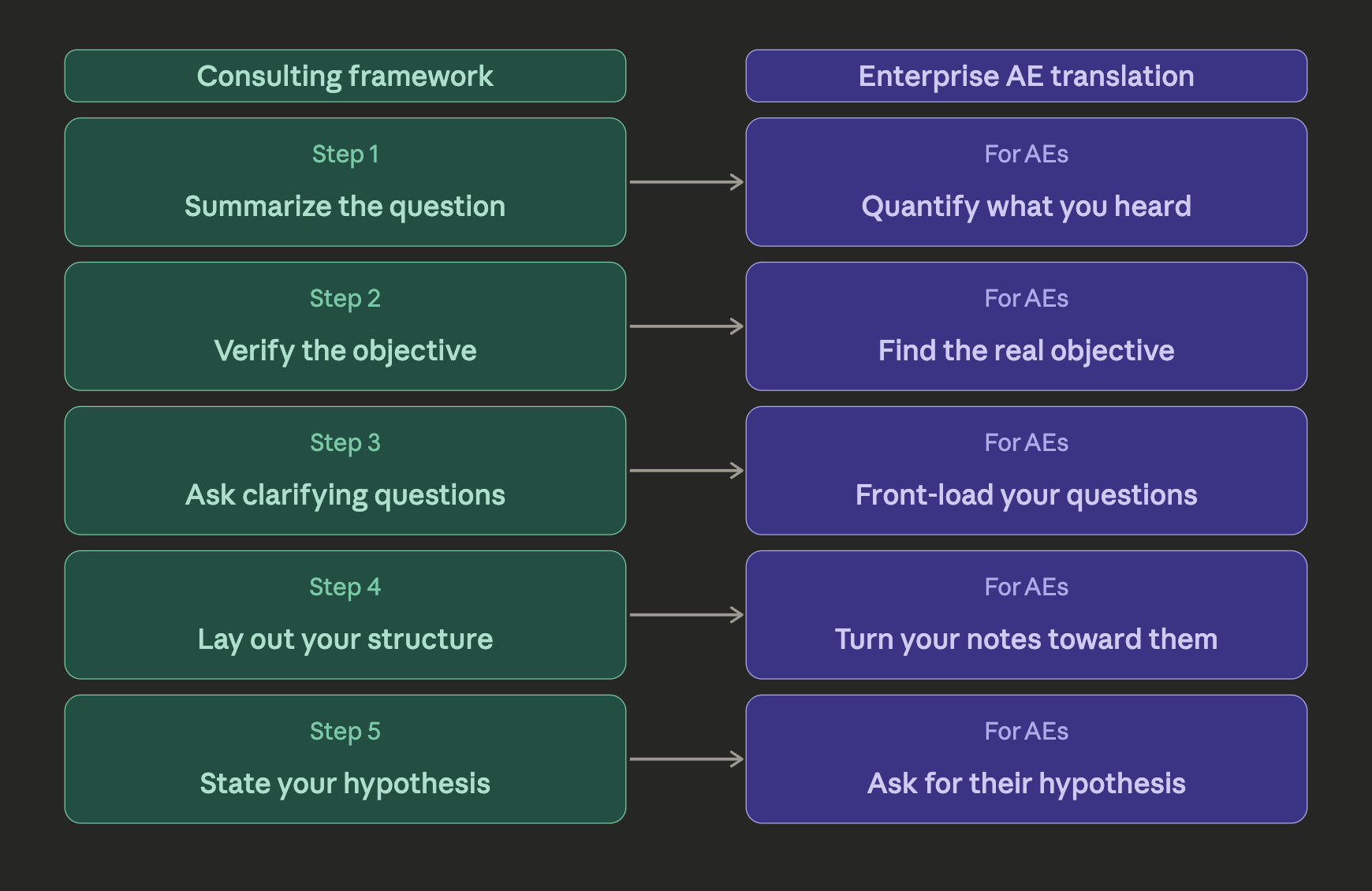
The five steps — translated
Step 1 — Summarize the question. Paraphrase what you've heard back in your own words. Quantify when possible. In selling: active listening isn't a soft skill, it's a diagnostic tool. When you feed back a number — "so you're saying churn in that segment is running about 18%" — you're confirming accuracy and signaling that you're operating in their reality, not pitching into a void.
Step 2 — Verify the objective. Confirm the stated goal, then probe for hidden ones. Cosentino's exact instruction: "Even if the objective seems obvious, ask." In selling: the stated objective is almost never the complete picture. The CFO says they want cost reduction. What they want is to make it to Q4 without a variance conversation. Find the real objective or you'll solve the wrong problem beautifully.
Step 3 — Ask clarifying questions early. Broad, open-ended questions belong at the beginning of a conversation. As the case progresses, you lose the "right" to sweeping questions. In selling: the window for foundational discovery closes faster than most reps realize. You can ask a CFO why they're evaluating this category in meeting one. In meeting four, you asking that question signals that you haven't been listening.
Step 4 — Label the case and lay out your structure. Consultants are explicitly told to take 90–120 seconds of silence to think and write before speaking. Then they turn their notes toward the interviewer and walk through the structure — physically orienting the notes so the interviewer feels like a client receiving a presentation, not a subject under examination. In selling: the reps who pause before responding are almost universally perceived as more credible. The reps who slide their laptop around and say "let me show you how I'm thinking about this" win more deals than the ones who pitch from memory
Step 5 — Ask for their hypothesis. Before diving into analysis, the consultant proposes a thesis to test — a stake in the ground that the rest of the case either confirms or dismantles. It's a show of command. The interviewer plays a client who hired you; arriving with a point of view signals you're already working.
In selling, the move inverts. After four steps of careful listening, structure, and framing, the most valuable thing you can do is ask the buyer what they think is true.
"Walk me through how you think about the root cause. What's your working theory?"
That question does three things at once: it surfaces intelligence you can't get any other way, it signals genuine respect for their thinking, and it puts the diagnosis in their words — which means they own it. A buyer who has articulated their own hypothesis is not a buyer you have to convince. They've already started convincing themselves.
The consultant states a hypothesis because the interview rewards it. The AE asks for one because the deal depends on it.
The twelve six scenarios as a deal qualification map
The second half of the Ivy Case System is a library of twelve case scenarios — each covering a distinct type of business problem a consultant might encounter. When you map them against the problems your buyers actually bring to you, the overlap is not coincidental.
Now the scenarios grid — which of Cosentino's twelve cases you're most likely to encounter in an enterprise discovery conversation.
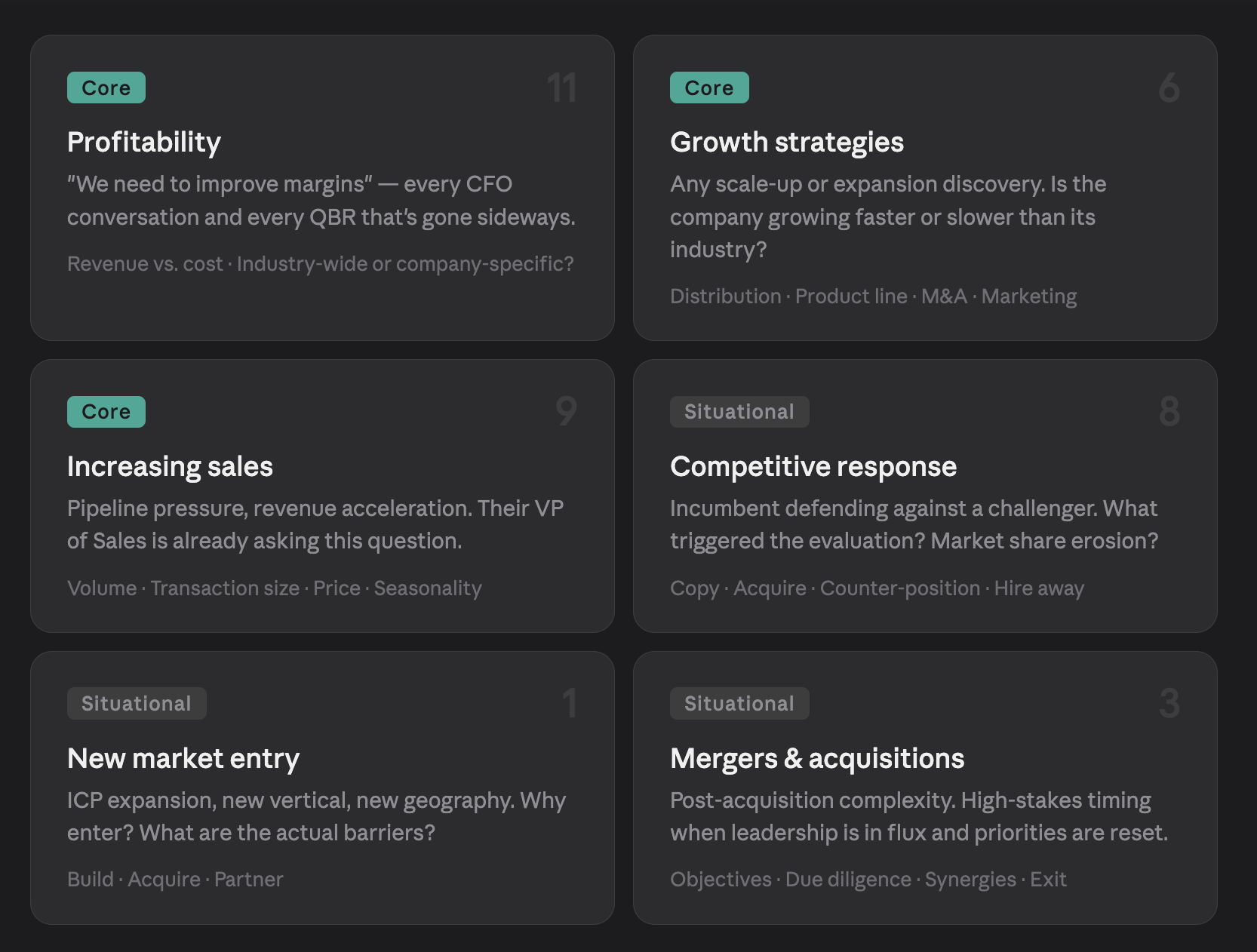
The point isn't to run a consulting engagement on your buyer. The point is that when a VP of Sales says "we need to do more with less this year," you can hear that as a Scenario 10 (cost reduction) with a Scenario 9 (increasing sales) constraint — and ask accordingly. Most reps hear it as an objection. You can hear it as a diagnostic.
On recommendations — and why most reps hedge themselves out of deals
Cosentino's instructions for delivering a recommendation are almost aggressive in their directness. Lead with the recommendation. No backstory. Be definitive. A clear yes or no, stated with confidence.
His exact phrase: "I think" is "the kiss of death."
Reps hedge because hedging feels safe. If you're not fully committed, you can't be fully wrong. What actually happens is that the buyer's confidence in you drops in direct proportion to your own apparent uncertainty. Executives make high-stakes decisions all day. They are not looking for someone to validate their confusion — they're looking for someone with a point of view they can push against.
He also instructs consultants: if the recommendation is "no," provide an alternative path. Don't just decline — show the client another route to their goal. In selling, this is the difference between losing a deal and deferring one. "I don't think we're the right fit for what you're trying to do in Q3, but here's what I'd be thinking about for Q1" is a sentence that generates more callbacks than any close technique in any playbook you've ever read.
The thing about confidence
The final chapter of Case in Point is the shortest. Cosentino's conclusion, after twelve scenarios, thirteen commandments, and hundreds of practice cases, is this: methodical preparation only goes so far. The most important thing you can bring into the room is "a perspective of self-worth and confidence."
His parting line: Often wrong, but never uncertain.
That's not a license for arrogance. It's an instruction to commit. To have a point of view. To say what you believe is true and update it when you're shown otherwise — not because pressure was applied, but because evidence was presented.
The reps who consistently win large, complex deals are not the ones with the best decks or the deepest product knowledge. They're the ones who make the buyer feel like they're talking to someone who has thought seriously about their situation and arrived at a conclusion worth hearing.